DNS monitoring
DNS monitoring allows you to check whether a name resolves, whether it resolves to the right thing, and whether the answer changed behind your back - by periodically querying the name with a real DNS resolver.
How does it work?
Kuvasz monitors your domain names by periodically sending DNS queries for them. For each check it measures and evaluates:
- Resolvability (whether the resolver answered at all, within the timeout)
- Resolution latency (the total time the check's assertion queries took)
- The answer itself (whether the returned records satisfy your assertions)
- The response code (whether the resolver returned what you expect, e.g.
NOERRORorNXDOMAIN)
If the resolver cannot be reached within the check's timeout budget, if the response code differs from the expected one, if any of the configured record matchers fails, or - when configured - if the resolution takes longer than the optional latency threshold, the monitor is marked as DOWN and you will be notified through your configured notification channels.
If you don't configure any record matcher, the check falls back to a plain A lookup, and the up/down status is decided by the response code alone: the monitor is UP as long as the resolver answers with the expected one, NOERROR by default.
Asserting on the records
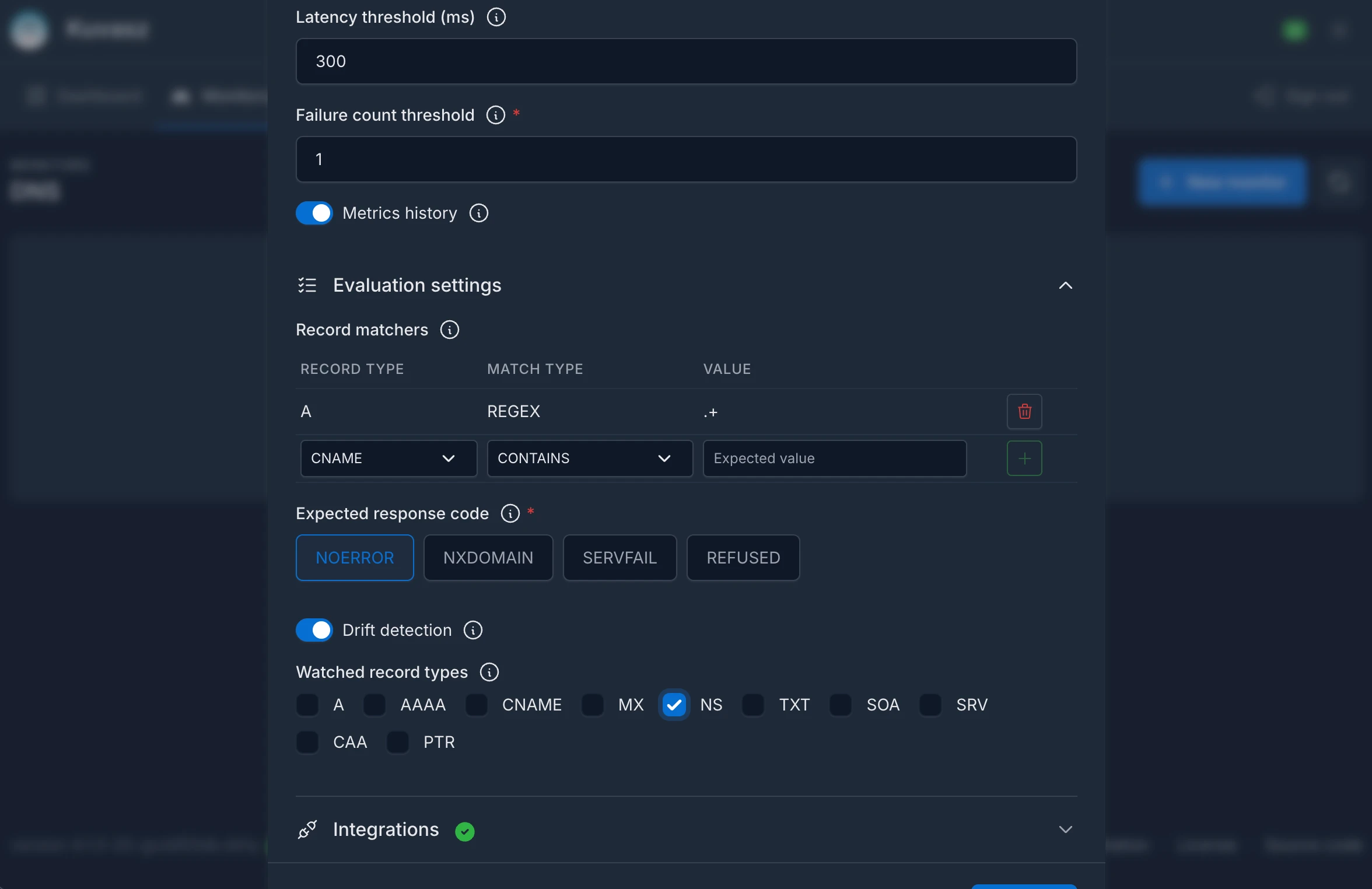
Instead of a single expected value, a DNS monitor holds a list of record matchers. Each matcher targets one record type (A, AAAA, CNAME, MX, NS, TXT, SOA, SRV, CAA, PTR) with a match type (EXACT, CONTAINS or REGEX) and a value.
- All matchers must pass (they are ANDed), and a single matcher passes when at least one record of its type satisfies it.
- Only the record types your matchers actually cover are queried, so a monitor never pays for lookups it doesn't need - unless you widen the drift watch list explicitly.
- The returned records are normalized to their canonical
digpresentation, andEXACT/CONTAINSvalues go through the same normalization before they are compared, so you can pastedigoutput verbatim.REGEXpatterns are used as-is and matched against the normalized record.
This model covers the everyday cases without any extra configuration: CONTAINS is enough for an SPF or DKIM fragment inside a long TXT record, two EXACT matchers express "both of these IPs must be present", and REGEX - using the Java / Kotlin regular expression syntax - handles everything else.
Drift detection
Beyond up/down, Kuvasz can tell you when the resolved records change - a hijacked delegation, an accidental NS switch during a migration, or an MX record someone edited without telling you.
When drift detection is enabled, Kuvasz keeps the last resolved answer set as a baseline, and whenever a check returns a different one, it sends a dedicated DNS_RECORDS_CHANGED notification and re-seeds the baseline. This is evaluated independently of the up/down status: a perfectly healthy monitor can - and should - report drift, since that is exactly the situation worth knowing about.
It is opt-in per monitor, because plenty of answer sets legitimately rotate (CDNs, short-TTL load balancers), and alerting on those would only produce noise.
What can be configured?
- interval for uptime checks
- the domain name to query
- an optional custom nameserver (host + port) instead of the system resolver
- the transport to use (
UDPwith automatic TCP fallback, or forcedTCP) - record matchers (record type + match type + value, all ANDed)
- the expected DNS response code (
NOERROR,NXDOMAIN,SERVFAIL,REFUSED) - check timeout budget, shared by every query of a check (1-30000 milliseconds)
- optional resolution-latency threshold that triggers a DOWN event
- consecutive failure count threshold
- drift detection, optionally scoped to specific record types
Configuration
Please refer to the Managing DNS monitors section of the documentation for more information on how to configure DNS monitoring.